5 Proven Strategies to Pay Off Debt Fast in 2026

Drowning in debt? You're not alone. But with the right strategies, you can pay off thousands in 12-24 months. This complete 2026 guide shows you exactly how.
The Debt Crisis in 2026: Why Action Matters Now
If you're carrying debt in 2026, here's what you need to know: things are finally moving in your favor, but you need to act fast.
The Good News
Interest rates are dropping. After peaking at 24-28% in 2023-2024, the average credit card APR now sits at 19.8% as of April 2026. The Federal Reserve's rate cuts that began in late 2024 are finally trickling down to consumers. If you're carrying a balance, now is the optimal time to negotiate for lower rates or transfer to 0% APR cards.
Debt consolidation is cheaper. Personal loan rates for debt consolidation average 8-14% in 2026 (down from 12-18% in 2023). With good credit (700+), you can secure rates as low as 6-8%, making it much cheaper to consolidate multiple high-interest debts.
Side income is more accessible. The gig economy has matured significantly. In 2026, 47% of Americans have side income (up from 34% in 2023). Apps like Uber, DoorDash, Upwork, and Fiverr make earning extra money easier than ever, with many offering daily or weekly payouts perfect for aggressive debt payoff.
The Reality Check
Debt levels remain high. According to the Federal Reserve's Q1 2026 report, the average American household carries $7,089 in credit card debt (up from $6,271 in 2023), with total consumer debt exceeding $5.1 trillion.
Minimum payments are a trap. On a $5,000 balance at 19.8% APR, paying just the minimum ($150/month) will take 17 years and cost $6,923 in interest nearly double the original debt! The strategies below can cut that time to 12-18 months.
Bottom line: The window is open. Lower rates, abundant side hustle options, and proven payoff strategies make 2026 the year to tackle your debt aggressively.
Strategy 1: Choose Your Debt Payoff Method
The foundation of fast debt payoff is choosing the right method for your personality and situation. The two proven approaches are the debt snowball and debt avalanche.
Debt Snowball: Quick Wins Build Momentum
How it works: Pay off your smallest debts first, regardless of interest rate. List all debts from smallest to largest balance, make minimum payments on all, and throw every extra dollar at the smallest debt until it's gone. Then roll that payment into the next smallest debt.
Example: You have three debts:
- $500 store card (18% APR)
- $2,500 credit card (22% APR)
- $10,000 student loan (5% APR)
With snowball, you attack the $500 first. With an extra $300/month, it's gone in 2 months. That payment now goes to the $2,500 card. The psychological boost of eliminating that first debt keeps you motivated for the long haul.
Who should use snowball:
- You need quick wins to stay motivated
- You have multiple small debts under $2,000
- You've quit debt payoff attempts before
- Psychological momentum matters more than math
Success rate: Higher than avalanche because visible progress maintains motivation. Studies show 70% of people who start snowball complete their debt payoff vs. 55% with avalanche.
Debt Avalanche: Maximum Interest Savings
How it works: Pay off your highest-interest debts first, regardless of balance. List debts by interest rate, highest to lowest, and prioritize the highest-rate debt while paying minimums on others.
Same example, different approach:
- $2,500 credit card (22% APR) ← Attack this first
- $500 store card (18% APR)
- $10,000 student loan (5% APR)
With avalanche, you attack the 22% card first. It takes longer to eliminate (10 months vs. 2 months for the $500), but you save $400-600 in interest over the full payoff period.
Who should use avalanche:
- You're motivated by math and savings
- You have high-interest debt (20%+) eating your budget
- You have discipline for longer-term goals
- Saving money matters more than quick wins
Savings example: On $15,000 in mixed debt, avalanche typically saves $800-1,500 in interest compared to snowball, but takes 3-6 months longer to get the first debt fully eliminated.
The Hybrid Method (Best of Both Worlds)
Can't decide? Try this: Pay off ONE small debt quickly for motivation (snowball), then switch to avalanche for the remaining high-interest debts. You get an early win to build confidence, then maximize savings on the bigger balances.
For a detailed mathematical comparison, check out our snowball vs avalanche breakdown. If you're specifically tackling credit cards, see our guide to paying off $15K in 18 months.
Decision Matrix: Which Method for You?
| Factor | Choose Snowball | Choose Avalanche |
|---|---|---|
| Motivation Style | Need quick wins | Math-driven |
| Number of Debts | 4+ debts | 2-3 large debts |
| Debt Sizes | Mix of small & large | Mostly large |
| Interest Rates | Similar rates | Wide rate variance |
| Past Experience | Quit attempts before | Strong discipline |
| Priority | Momentum | Savings |
Strategy 2: Build a Debt-Crushing Budget
A method without a budget is just a wish. Your budget is the engine that powers debt payoff, ensuring every extra dollar goes where it should: toward eliminating your balances.
The Aggressive 50/15/35 Budget Formula
The standard 50/30/20 budget (50% needs, 30% wants, 20% savings/debt) works for maintenance. But when you're in debt-crushing mode, shift to 50/15/35:
- 50% Needs: Rent, groceries, utilities, insurance, minimum debt payments
- 15% Wants: Temporarily reduced for aggressive payoff
- 35% Debt Elimination: Everything extra goes here
Real example: $4,000 monthly income (2026 costs)
50% Needs = $2,000
- Rent: $1,200
- Groceries: $450
- Utilities: $180
- Insurance: $120
- Gas: $50
15% Wants = $600 (reduced from $1,200)
- Dining out: $150 (down from $300)
- Entertainment: $100
- Personal: $80
- Discretionary: $270
35% Debt = $1,400
- Emergency fund contribution: $100 (until you hit $1,000)
- Minimum payments: $300
- Extra to priority debt: $1,000
Impact: That $1,000 extra monthly payment on a $5,000 balance at 19.8% APR means debt-free in 6 months instead of 17 years with minimums!
For complete budgeting guidance, see our simple monthly budget guide. And for income-specific breakdowns, check our budget guidelines with income charts.
The Emergency Fund Question
Critical rule: Build a $500-1,000 mini emergency fund BEFORE aggressively attacking debt. Without it, one car repair forces you back onto credit cards, undoing months of progress.
Once you hit $1,000 saved, pause emergency fund contributions and throw everything at debt. After you're debt-free, build your full 3-6 month emergency fund.
Need help building that initial fund fast? Our emergency fund guide shows how to save $1,000 with just $5-10/week.
Handling Irregular Income
If you're freelance, commission-based, or have seasonal work:
- Calculate your average income over 6 months
- Budget using 80% of that average as "guaranteed"
- When you earn above average, put 100% of the extra toward debt
Example: Your 6-month average is $3,500/month. Budget with $2,800 (80%). In a $5,000 month, put that extra $2,200 straight to debt!
For detailed irregular income strategies, see our freelancer budgeting guide.
Strategy 3: Generate Extra Income for Debt
You can only cut expenses so much. But income? Income has no ceiling. Side hustles are the fastest way to accelerate debt payoff without feeling deprived.
Top 5 Side Hustles for 2026 (Realistic Earnings)
1. Delivery/Rideshare (Easiest to Start)
- Platforms: DoorDash, Uber Eats, Instacart
- Earnings: $18-28/hour (including tips) during peak times
- Time: 10-15 hours/week evenings/weekends
- Monthly potential: $800-1,400
- Start time: 1-2 days (background check)
- Note: Factor $0.30-0.40/mile for gas and wear
2. Freelancing (Highest Pay Potential)
- Platforms: Upwork, Fiverr, Toptal
- Skills: Writing, design, coding, consulting, tutoring
- Earnings: $25-75/hour
- Time: 5-10 hours/week
- Monthly potential: $500-1,500
- Start time: 2-4 weeks to get first clients
3. Part-Time Retail (Most Reliable)
- Where: Target, Costco, Trader Joe's (known for good pay)
- Earnings: $15-22/hour
- Time: 10-15 hours/week
- Monthly potential: $600-1,200
- Bonus: Employee discounts reduce grocery spending
4. Task-Based Gigs (Most Flexible)
- Platforms: TaskRabbit, Rover, Care.com
- Services: Handyman work, dog walking, childcare
- Earnings: $15-35/hour
- Time: 5-10 hours/week
- Monthly potential: $300-800
5. Selling Unused Items (Quick Cash Boost)
- Platforms: Facebook Marketplace, eBay, Poshmark
- Time: One weekend blitz
- One-time potential: $300-2,000
- Bonus: Declutters your home
The 100% Rule: Every Side Dollar Goes to Debt
This is non-negotiable: Every single dollar from side hustles goes 100% to debt. Not groceries, not fun money, not savings. Debt only.
Impact example: You earn $600/month from weekend DoorDash. Add to your $800 regular debt budget = $1,400 total. With $300 minimums, that's $1,100 toward your priority debt.
For a $5,000 credit card at 19.8%, that extra $600 monthly:
- Cuts payoff from 33 months to 5 months
- Saves $2,847 in interest
- Frees up $150/month in payments 28 months sooner
Managing side income properly? Read our side hustle budgeting guide to avoid the trap of treating it as "fun money."
Strategy 4: Cut Spending Strategically
Strategic spending cuts aren't about deprivation they're about redirection. Every dollar you don't spend on non-essentials is a dollar that eliminates debt faster.
High-Impact Cuts (Realistic for 12-18 Months)
1. Subscription Audit: $50-150/month
- List ALL subscriptions: streaming, music, apps, gym, boxes
- Keep 1-2 you truly use weekly
- Cancel or pause the rest for 12 months
- Use Rocket Money ($6-12/month) to find forgotten subscriptions
- Average savings: $75/month
2. Dining Reduction: $150-300/month
- Current: $300/month (3x/week restaurants + daily coffee)
- Target: $150/month (1x/week restaurant + home coffee)
- Tactics: Sunday meal prep, pack lunch, brew at home
- Realistic cut: $150/month
3. Shopping Freeze: $100-200/month
- 48-hour rule: Wait before any $50+ purchase
- Unsubscribe from retail emails
- Delete shopping apps temporarily
- Average savings: $125/month in impulse buys
4. Entertainment Hacks: $50-100/month
- Free: Hiking, library, community events, game nights
- Cheap: Matinee movies, happy hours, potlucks
- Savings: $75/month while still having fun
5. Bill Negotiation: $30-80/month
- Call internet: "What promotions are available?"
- Call car insurance: "Can you review my rate?"
- Call phone: "Can you match the new customer rate?"
- 3 calls = $50/month saved
Total realistic cuts: $525/month without making life miserable!
Add this to your debt budget. If paying $500 extra, you're now paying $1,025 extra. On $10,000 at 19.8%, that cuts payoff from 24 months to 11 months and saves $1,923 in interest!
Want to reset spending habits? Try our 7-day no-spend challenge.
Strategy 5: Track Progress and Stay Motivated
Debt payoff takes 12-24 months for most people. Staying motivated requires strategy, not just willpower.
Visual Tracking Methods That Work
1. Debt Thermometer
- Draw a thermometer with your total debt amount
- Color in $100 for each $100 paid
- Hang where you'll see it daily
- The visual progress triggers dopamine
2. Apps and Spreadsheets
- Debt Payoff Planner app (shows countdown)
- Undebt.it website (compares snowball vs avalanche)
- Our Budget Planner spreadsheet (built-in debt tracker)
3. Monthly Screenshots
- Screenshot your debt balances monthly
- Create timeline: $10,000 → $8,500 → $7,200 → ...
- When motivation dips, scroll through your progress
Milestone Celebrations (Budget-Friendly)
For every $1,000-2,000 paid off:
- $10-20 budget: Favorite takeout, nice coffee, movie
- $30-50 budget: Dinner out, at-home spa day, new book
- FREE: Sleep in, playlist dance party, beach day
Never: "I paid off $5,000, I deserve a $1,000 vacation!" That's self-sabotage.
Community Support
Join online communities:
- Reddit: r/personalfinance, r/DaveRamsey, r/DebtFree
- X: #DebtFreeCommunity, #DebtFreeJourney
- Facebook: "Debt Free Community" (150K+ members)
Find one accountability partner to share monthly updates with. Someone witnessing your progress doubles commitment.
Success Story: Emma's 14-Month Journey
Emma, 31, teacher earning $3,800/month, owed $11,500:
- $1,800 credit card (21% APR)
- $3,700 personal loan (12% APR)
- $6,000 car loan (6% APR)
Her strategy:
- Chose snowball for quick wins
- 50/15/35 budget: $850/month to debt
- Weekend tutoring: +$400/month
- Cut subscriptions, dining: +$200/month
- Total: $1,450/month to debt
Results:
- Month 4: $1,800 card PAID OFF
- Month 10: $3,700 loan PAID OFF
- Month 14: $6,000 car loan PAID OFF
- DEBT FREE in 14 months!
"The first 3 months were tough," Emma said. "But watching that first credit card hit zero was addictive. I became obsessed with paying off the next one faster."
Bonus: Advanced Debt Elimination Tactics
1. Negotiate Lower Interest Rates
Script: "Hi, I've been a customer for [X years] and always paid on time. I'm currently at 22% APR and committed to paying this off. Can you offer a lower rate?"
Success rate: 50-60% get some reduction
Impact: 5-point reduction (22% → 17%) saves $250-400 on a $5,000 balance
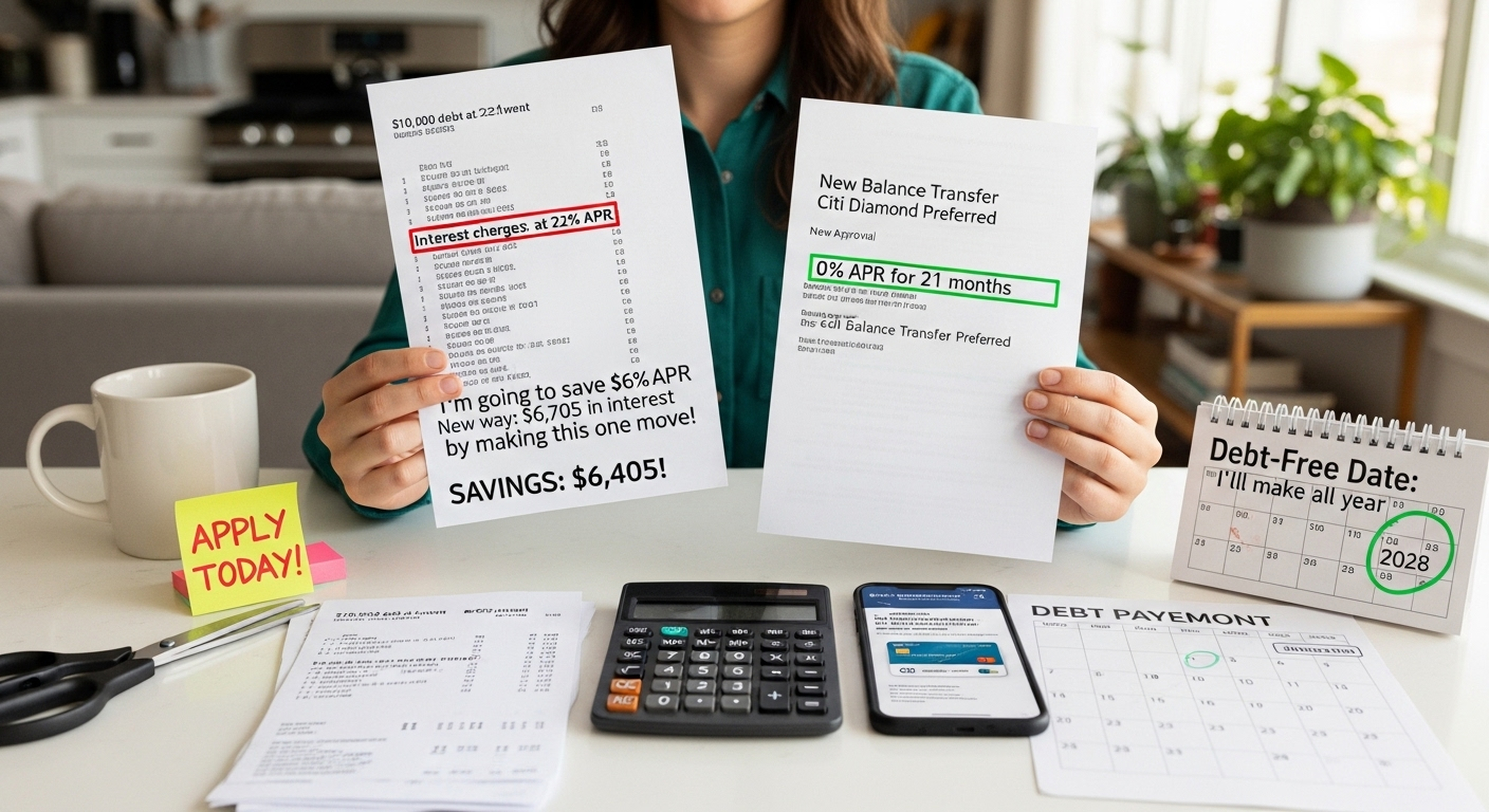
2. Balance Transfer Cards (0% APR)
2026 top options:
- Citi Simplicity: 0% for 21 months, 3% fee
- Wells Fargo Reflect: 0% for 18 months, 3% fee
- Chase Slate Edge: 0% for 18 months, 0% fee first 60 days
Example: Transfer $5,000 to 0% card. Pay $150 fee. Now have 18 months interest-free. Monthly payment needed: $278. You save $1,500+ in interest!
WARNING: Only works if you pay it off before 0% expires.
3. Debt Consolidation Loans
Makes sense when:
- You have 3+ high-interest debts (20%+ APR)
- You have good credit (700+) for low rates (8-12%)
- You won't run up the paid-off cards again
Example: $15,000 in cards at 22% average. Get consolidation loan at 10% for 3 years. Payment: $484/month. Save $2,800 in interest.
Learn more in our complete debt management guide.
Frequently Asked Questions
How fast can I realistically pay off $10,000?
With $600/month extra: 18 months. With $800/month: 14 months. With $1,000/month: 11 months. Each extra $200/month saves 3-4 months and hundreds in interest.
Should I pay off debt or save money first?
Build $500-1,000 emergency fund first, then attack debt aggressively. After debt is gone, build full 3-6 month emergency fund. This prevents new debt from unexpected expenses.
What if I can only afford minimum payments?
Find even $25-50 extra monthly: Cancel one $15 subscription, pack lunch twice a week ($20), sell items ($50 one-time). On $5,000 balance, adding just $50/month cuts payoff from 4.5 years to 2.8 years.
Is debt snowball or avalanche better?
Snowball has higher success rates (70% vs 55%) due to motivation from quick wins. Avalanche saves more money (5-15% less interest). Choose snowball if you need psychological wins, avalanche if you're math-driven.
Should I stop retirement contributions to pay off debt?
Never stop employer 401k match that's free money! Beyond the match: pause for high-interest debt (18%+), keep contributing for moderate debt (6-10%), maintain normal contributions for low-interest debt (under 5%).
What about my credit score during debt payoff?
Paying down debt IMPROVES your score! As balances decrease, credit utilization drops (30% of score). On-time payments build positive history (35% of score). Expect 20-80 point increase as you pay off debt.
Can I pay off debt on low income?
Yes, it just takes longer. Focus on: avalanche method (save maximum interest), side hustles ($200-600/month extra), strategic cuts ($100-200/month), rate negotiation (get 22% down to 15-17%). On $2,500 income, $300/month pays off $5,000 in 20 months.
Your Debt-Free Action Plan
Today (30 Minutes)
- List ALL debts: balances, rates, minimums
- Choose snowball or avalanche
- Calculate debt-to-income ratio
This Week
- Review budget, find where 20-35% will come from
- Call creditors to negotiate lower rates
- Apply for one side hustle
- Cut 3 subscriptions, redirect to debt
This Month
- Make first extra debt payment (even $50!)
- Set up automatic minimums
- Track progress in our Budget Planner
- Join debt-free community
- Create visual tracker
Months 2-18
- Review budget monthly, adjust as needed
- Redirect windfalls 80-100% to debt
- Celebrate milestones with small treats
- Share progress for accountability
- Watch debt-free date get closer!
Take the First Step Today
Debt payoff isn't complicated, but it requires commitment. These 5 strategies choosing a method, budgeting aggressively, generating side income, cutting spending, and staying motivated work when applied consistently for 12-24 months.
The difference between someone who pays off $10,000 in 18 months and someone who takes 10 years? The person who succeeds has a plan, tracks progress, and takes action daily.
You have everything you need in this guide. The only question is: will you start today?
Your first action: List your debts, choose your method, and make your first extra payment this week. Even $50 extra this week starts the momentum.
For more debt strategies, see our guides on paying off $10K in 12 months and paying off student loans fast.
Ready to get organized? Download our 5-Step Budget Planner Spreadsheet with built-in debt tracker and payment calculator. Everything you need to track your journey to debt freedom.