6 Budgeting Mistakes Young Professionals Make in 2026 (And How to Fix Them)
You're earning good money, but somehow still living paycheck to paycheck. You tried budgeting once it lasted two weeks. Sound familiar? You're not alone, and you're not failing. You're just making the same six mistakes most young professionals make in 2026.
Why Budgeting in 2026 Is Different (And Harder Than Ever)
If you're a young professional earning $55,000-90,000 annually, you should theoretically be building wealth. But here's the 2026 reality:
The Financial Landscape Young Professionals Face
Costs have exploded:
- Median rent (1-bedroom): $1,750/month ($21,000/year)
- Average student loan payment: $380/month ($4,560/year)
- Groceries for one: $450-550/month ($5,400-6,600/year)
- Health insurance (employer-subsidized): $200-300/month
- Car insurance: $150-220/month
New expense categories didn't exist 10 years ago:
- Streaming services: Average 4.2 subscriptions × $14/each = $59/month
- App subscriptions: Fitness, productivity, news = $40-80/month
- Delivery apps: DoorDash, Uber Eats = $150-300/month average
- Subscription boxes, meal kits, wellness apps = $50-100/month
Social pressure is intense: Your Instagram feed shows friends traveling, dining at trendy restaurants, wearing designer clothes. FOMO (fear of missing out) leads to spending beyond means.
Financial literacy wasn't taught: Despite earning professional salaries, most young professionals never learned practical budgeting, investing, or money management.
But here's the opportunity: Fix these six mistakes, and you'll immediately separate yourself from the 78% of young professionals living paycheck to paycheck despite good incomes.
The Stakes: Why This Actually Matters
Budgeting is essential for financial success, but many young professionals fall into common traps that derail their progress. Even with good intentions, subtle mistakes can lead to:
- Chronic stress: 64% of young professionals report money anxiety (APA 2026)
- Debt accumulation: Average credit card balance for ages 25-34: $4,200 at 19.8% APR
- Missed opportunities: Can't invest, buy a home, or build wealth
- Relationship strain: Money fights are the #1 cause of relationship stress
- Career limitations: Can't afford professional development or career transitions
Here's the truth: budgeting isn't hard because you're bad with money. It's hard because most people are taught strategies that don't work in real life. Overly restrictive plans that ignore human psychology. One-size-fits-all formulas that don't account for your unique 2026 situation. Rigid rules that crack under the pressure of modern life.
But when you understand the most common mistakes—and more importantly, how to fix them budgeting transforms from a frustrating chore into a powerful tool for building wealth and achieving financial freedom.
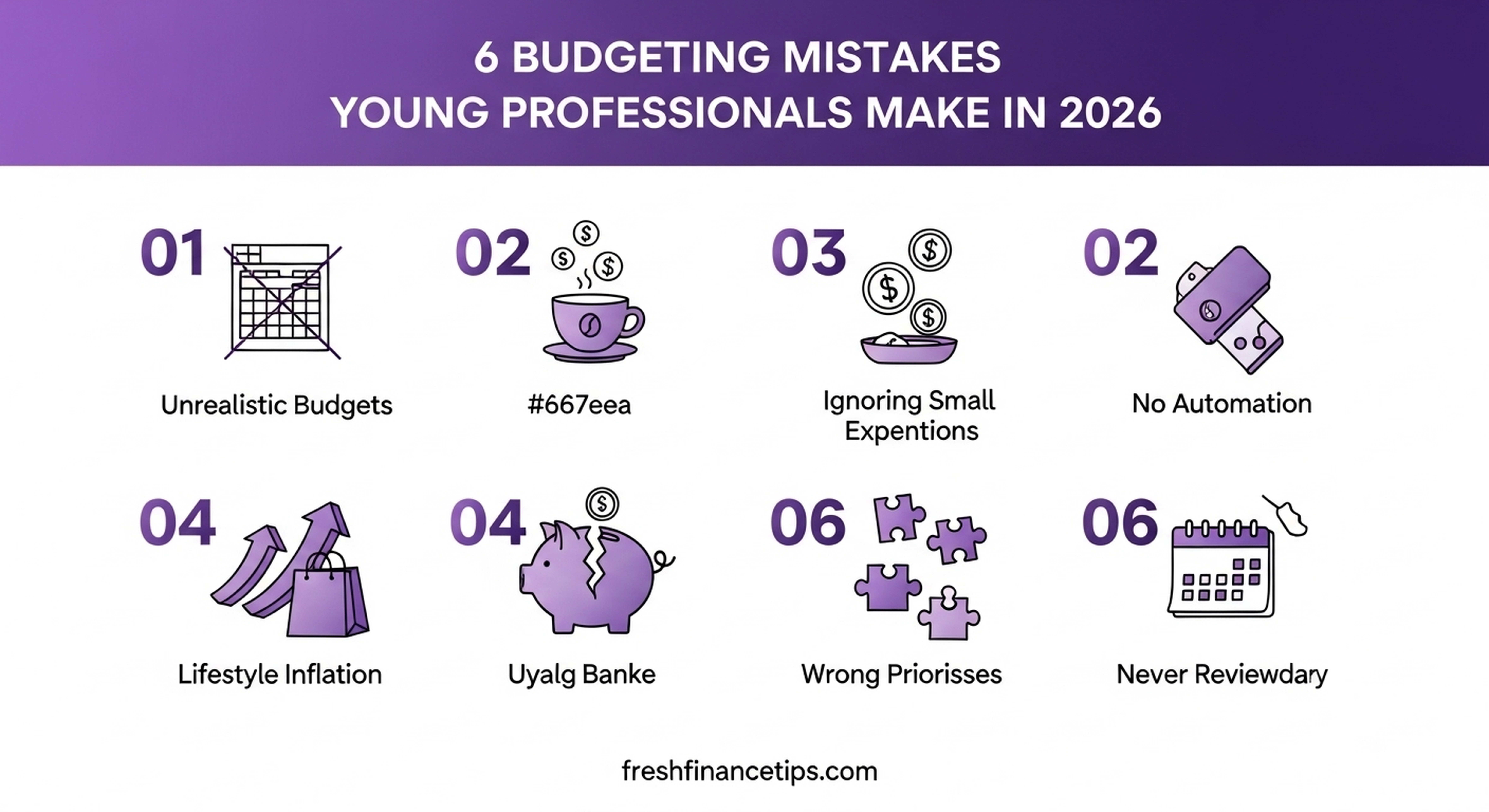
Let's break down the six biggest budgeting mistakes young professionals make in 2026, and show you exactly how to fix each one.
Mistake 1: Creating Unrealistic Budgets That Doom You From Day One
The number one reason budgets fail? They're built on fantasy, not reality.
You decide to cut all "fun" spending to zero, slash your grocery budget by 50%, eliminate every subscription overnight, and never eat out again. It looks impressive in your spreadsheet. Then reality hits on Day 3.
Why Unrealistic Budgets Fail
It's unsustainable: Humans aren't robots we need joy, spontaneity, and flexibility. Extreme restriction works for 5-10 days, then willpower collapses.
It triggers rebellion: Just like crash diets lead to binge eating, extreme budget restriction leads to binge spending. You'll "reward" yourself for 2 weeks of deprivation with $500 of impulse purchases.
It ignores reality: Cars break down. Friends get married. Your company has a holiday party. Seasonal expenses (holidays, summer travel) aren't optional for most people.
It creates shame spirals: One "failure" (ordering $30 takeout after a brutal work week) makes you feel like you've blown it, so you abandon the entire budget.
Real-World Example (2026)
Sarah, 28, marketing manager earning $72,000, creates a budget:
- Groceries: $200/month (down from realistic $480)
- Entertainment: $0 (down from $300)
- Dining out: $0 (down from $280)
- Shopping: $0 (down from $150)
Week 1: Motivated, meal preps, declines happy hour
Week 2: Stressed from work, orders DoorDash 3× ($90), feels guilty
Week 3: "I already failed," stops tracking, spends $400 on impulse shopping to cope
Week 4: Abandoned budget entirely, now spending MORE than before ($1,500 vs. previous $1,210)
The Fix: Build a Realistic, Sustainable Budget
Step 1: Start with the 50/30/20 Framework (Adjusted for 2026)
This proven framework creates balance and flexibility:
- 50% Needs: Rent/mortgage, utilities, groceries, transportation, insurance, minimum debt payments, health costs
- 30% Wants: Dining out, entertainment, hobbies, shopping, subscriptions, travel
- 20% Savings/Debt: Emergency fund, retirement, extra debt payments beyond minimums, goal savings
2026 example: $6,000/month take-home ($72K salary)
| Category | Allocation | Example Breakdown |
|---|---|---|
| Needs (50%) | $3,000 | Rent $1,750, Utilities $180, Groceries $480, Car $350, Insurance $240 |
| Wants (30%) | $1,800 | Dining $400, Entertainment $250, Subscriptions $70, Shopping $200, Misc $880 |
| Savings/Debt (20%) | $1,200 | 401(k) $500, Emergency Fund $400, Extra Debt $300 |
Step 2: Track Actual Spending for 30 Days BEFORE Finalizing Categories
Don't guess what you spend KNOW it. Use Monarch Money, YNAB, or even just export your bank/credit card statements to a spreadsheet.
How to track:
- Log into all accounts (checking, credit cards, Venmo, PayPal)
- Export last 30 days of transactions
- Categorize every single transaction
- Calculate totals per category
- Use THAT as your budget baseline, not fantasy numbers
Step 3: Build 5-10% Buffer for "Life Happens"
Life isn't predictable. Your budget needs flex room. Add a "buffer" or "miscellaneous" category:
- Car repairs, medical copays, wedding gifts, forgotten expenses
- $300-600/month buffer prevents derailment
- If you don't use it? Bonus money to savings!
Step 4: Make Gradual Changes, Not Dramatic Cuts
Currently spending $400/month dining out? Don't drop to $50 overnight. Use this gradual approach:
- Month 1: Track current spending ($400), no changes yet
- Month 2: Reduce to $320 (one fewer dinner out/week)
- Month 3: Reduce to $250 (pack lunch 2x/week)
- Month 4: Stabilize at $200-250 (sustainable long-term)
Sustainable gradual change beats dramatic failure every time.
For a complete guide on building a realistic budget that actually works for your 2026 life, check our step-by-step budgeting guide.
Mistake 2: Ignoring Small Daily Expenses (The Death by a Thousand Cuts)
Yes, we've all heard "stop buying coffee and you'll be rich." That's oversimplified nonsense. But the underlying truth remains: small daily expenses compound into shocking monthly totals that sabotage bigger goals.
The Real Cost of "Small" Expenses in 2026
Common small expenses young professionals ignore:
| Daily Expense | Per Day | Monthly | Yearly |
|---|---|---|---|
| Coffee shop (5x/week) | $6.50 | $130 | $1,560 |
| Lunch out (3x/week) | $15 | $180 | $2,160 |
| Parking/tolls | $8 | $160 | $1,920 |
| Forgotten subscriptions (avg 4) | - | $70 | $840 |
| Impulse online shopping | - | $120 | $1,440 |
| Convenience store runs | $5 | $100 | $1,200 |
| TOTAL | - | $760 | $9,120 |
That's $9,120/year! Enough for:
- Full emergency fund (6 months expenses)
- OR max out Roth IRA ($7,000) + extra savings
- OR pay off significant debt
- OR down payment progress on a home
The problem isn't any single $6 coffee it's the compound effect of dozens of "harmless" daily expenses you're not tracking.
The Fix: Track, Trim, and Redirect
Strategy 1: Sunday 10-Minute Money Review (The Game-Changer)
Every Sunday evening, spend 10 minutes reviewing the past week:
- Open Monarch Money, YNAB, or bank apps
- Review every transaction from past 7 days
- Categorize anything uncategorized
- Notice patterns: "Hmm, I ordered takeout 5 times this week"
- No judgment—just awareness
The psychology: Weekly review catches problems before they compound. Monthly review is too late you've already spent $500 extra.
Strategy 2: Use Automatic Round-Up Savings (Set and Forget)
2026 apps that do this:
- Acorns: Rounds up purchases, invests the difference ($25-50/month saved automatically)
- Qapital: Custom rules (save $5 every coffee purchase, round-ups, etc.)
- Chime: Auto-save 10% of every paycheck + round-ups
- Digit: AI analyzes spending, auto-saves safe amounts daily
Impact: $0.53 here, $0.87 there = $35-60/month without thinking about it = $420-720/year
Strategy 3: The 2026 Subscription Purge
Average young professional has 7.3 subscriptions totaling $142/month ($1,704/year). But they only actively use 3-4 of them.
Common forgotten subscriptions:
- Streaming services you don't watch ($15-20 each)
- Gym memberships unused for months ($40-80)
- Premium app upgrades you don't need ($10-30)
- Beauty/meal boxes you forgot to cancel ($25-60)
- Software you no longer use ($10-50)
How to purge:
- Use Rocket Money or Truebill to find ALL recurring charges
- For each: "Did I use this in the past 30 days?"
- If NO → Cancel immediately
- If YES → Ask: "Is this worth [cost]?"
- Target: Cancel 3-5 subscriptions = Save $60-150/month
Strategy 4: The 48-Hour Rule for Impulse Buys
For any non-essential purchase over $30:
- Add to Amazon cart/wishlist, don't buy
- Set phone reminder for 48 hours later
- Revisit after 48 hours
- Result: 65-70% of impulse purchases no longer feel necessary
For cutting small expenses without feeling deprived, see our guide to saving $1,000 in 30 days.
Mistake 3: Not Automating Savings (The "Leftover Money" Myth)
Here's how most young professionals approach savings: "I'll save whatever is left at the end of the month."
Here's what actually happens: There's never anything left at the end of the month.
Money sitting in checking accounts gets spent. Period. It's not a willpower issue it's human psychology. Present bias (wanting immediate gratification) beats future thinking (retirement, emergency fund) every single time.
Why Manual Saving Fails in 2026
Decision fatigue: You're making 35,000+ decisions daily. By evening, willpower is depleted. That "transfer to savings" gets postponed indefinitely.
Visibility bias: Money you can see in checking is money you'll spend. It's too accessible, too tempting.
Lifestyle expansion: Your spending naturally expands to fill available cash. $3,000 in checking? You'll find ways to spend $3,000.
Friction: Every manual step (log in, transfer, confirm) is an opportunity to talk yourself out of saving.
The Fix: Automate Everything (Pay Yourself First)
The Complete 2026 Automation Framework:
Step 1: Set Up Day-After-Payday Transfers
Schedule automatic transfers for the day after your paycheck hits:
- If new to saving: Start with 5% of take-home pay
- Every 3 months: Increase by 1% until you hit 20%
- Example: $6,000 monthly take-home → Start with $300/month auto-transfer
- After 12 months: Up to $720/month ($8,640/year saved automatically!)
Step 2: Multi-Account System (Separating Money by Purpose)
| Account Type | Purpose | Where to Open |
|---|---|---|
| Checking (Bills) | Rent, utilities, fixed expenses | Current bank (convenience) |
| Checking (Spending) | Groceries, gas, fun money | Current bank or Chime |
| HYSA (Emergency) | 3-6 months expenses | Marcus (5.0%), Ally (4.8%) |
| HYSA (Goals) | House, car, wedding, travel | Marcus, Discover, Capital One |
| 401(k)/IRA | Retirement, long-term wealth | Employer 401(k), Vanguard, Fidelity |
The psychology: Separate accounts create "mental accounting" money in "Emergency Fund" feels untouchable. Money in "Spending" feels spendable.
Step 3: Enable Direct Deposit Splitting (The Ultimate Automation)
Many employers allow you to split direct deposit across multiple accounts:
Example split on $6,000 monthly take-home:
- $3,600 (60%) → Checking (bills + spending)
- $1,200 (20%) → High-Yield Savings (emergency + goals)
- $600 (10%) → Roth IRA (auto-invest)
- $600 (10%) → Extra debt payoff or additional goals
Why this works: You never see the savings money in checking. Can't spend what you don't have access to!
For automation strategies within a complete financial system, see our guide to saving for your goals.
Mistake 4: Falling Into the Lifestyle Inflation Trap
You get a raise. Fantastic! You're finally making progress financially. You celebrated, updated LinkedIn, told your parents.
But somehow, 12 months later, you're not any better off financially. In fact, you might have LESS in savings than before the raise. What happened?
Lifestyle inflation (also called "lifestyle creep") happens when salary increases lead to proportional or greater spending increases rather than increased savings.
The 2026 Lifestyle Inflation Cycle
Real example: Alex gets promoted, $70K → $85K salary (+$15K/year, +$950/month after taxes)
Immediate lifestyle upgrades:
- Move to nicer apartment: +$300/month
- Lease newer car instead of driving old paid-off one: +$450/month
- Upgrade to "treat yourself" spending (nicer dinners, clothes): +$250/month
- Add premium subscriptions (HBO Max, premium Spotify, gym upgrade): +$50/month
Total new spending: $1,050/month
After-tax raise: $950/month
Net wealth increase: -$100/month (WORSE off!)
Why Lifestyle Inflation Is So Dangerous
It's invisible: Spending creeps up gradually over 3-6 months, not all at once. You don't notice until it's entrenched.
It's rationalized: "I deserve this, I work hard." "I can afford it now." "Everyone at my level has this." All psychologically true, all financially destructive.
It's social: Coworkers at your new level drive nicer cars, live in better neighborhoods, wear designer clothes. Keeping up feels mandatory.
It's a trap: Higher fixed expenses make you dependent on current income. Job loss, industry downturn, or health issue becomes catastrophic instead of manageable.
The Fix: Bank Half Your Raises, Delay Major Upgrades
Strategy 1: The 50/25/25 Rule for Salary Increases
When you get a raise, bonus, or promotion:
- 50% → Automated to savings/investments (before it hits checking)
- 25% → Debt payoff or additional financial goals
- 25% → Enjoy as lifestyle improvement (guilt-free!)
Example on $15K raise ($950/month after taxes):
- $475 → Auto-transfer to high-yield savings + Roth IRA
- $237 → Extra debt payment or house fund
- $238 → Enjoy (nicer dinners, better gym, small upgrades)
Result after 12 months:
- Savings/investment increase: $5,700
- Debt reduction/goal progress: $2,844
- Improved lifestyle: $2,856
- Total wealth increase: $8,544 (vs. $0 or negative with full lifestyle inflation)
Strategy 2: The 6-Month Major Purchase Delay
Before making any major lifestyle upgrade after a raise:
- Wait 6 months minimum
- Proves raise is sustainable (not temporary project or bonus)
- Gives time to adjust to new income level
- Prevents impulsive upgrades you'll regret
- 80% of "must-have" upgrades lose appeal after 6 months
Strategy 3: Track Net Worth Monthly (The Reality Check)
Most people track spending. Winners track net worth.
Monthly net worth calculation:
- Assets: Savings + investments + retirement + home equity
- Minus Liabilities: Credit cards + loans + student debt + car loan
- Equals Net Worth
The rule: If net worth isn't growing by at least 15-20% of your gross income annually, lifestyle inflation is winning.
Example: Earning $85,000, your net worth should grow by $12,750-17,000/year. If it's only growing $3,000-5,000/year, you have a lifestyle inflation problem.
Mistake 5: Budgeting in Isolation (Ignoring Financial Priorities)
Many young professionals create a budget focused solely on monthly income and expenses, completely ignoring debt, emergency funds, retirement, or future goals.
This leads to incomplete financial plans that look good on paper but fail in reality.
Examples of Isolated Budgeting Failures
- You budget $300 for "fun money" while carrying $8,000 in 21% credit card debt
- You save for a $3,000 vacation while having $0 emergency fund
- You invest $500/month while ignoring $15,000 in student loans at 7%
- You budget perfectly but have no specific financial goals beyond "save money"
The Fix: Follow the Proven Financial Priority Order
Your budget must exist within a broader financial strategy. Here's the proven sequence:
Priority 1: Build $1,000 Starter Emergency Fund
- Why first: Prevents new debt when unexpected costs hit (car repair, medical, etc.)
- Timeline: 1-2 months with focused effort
- How: Aggressive spending cuts + sell unused items + temporary side hustle
Priority 2: Get Full Employer 401(k) Match
- Why second: Free money you cannot pass up (100% instant return!)
- Example: Employer matches 50% up to 6% → contribute 6% to get full match
- On $70K salary: Your $4,200 + employer $2,100 = $6,300/year
Priority 3: Pay Off High-Interest Debt (10%+ APR)
- Why third: High-interest debt costs more than investment returns
- Focus on: Credit cards (19-24%), payday loans, store cards
- Method: Debt avalanche (highest interest first) or snowball (smallest balance first)
For complete debt elimination strategies, see our guides on paying off debt fast or eliminating $10K in 12 months.
Priority 4: Increase Retirement to 15% of Income
- Why fourth: Time is your biggest wealth-building asset
- Target: 15% total (including employer match)
- On $70K: $10,500/year ($875/month)
- Where: Max 401(k) match first, then Roth IRA, then back to 401(k)
Priority 5: Complete 3-6 Month Emergency Fund
- Why fifth: Full protection against job loss or major expenses
- Amount: 3 months for stable job, 6 months for variable income or single income household
- Example: $3,500/month expenses × 6 = $21,000 fully funded emergency fund
Priority 6: Save for Specific Goals
- House down payment
- Wedding
- Major travel
- Car purchase (cash)
- Additional investing
Critical principle: Don't skip steps. Budgeting for vacation while carrying 22% credit card debt is like watering flowers while your house is on fire.
Mistake 6: Never Reviewing or Adjusting Your Budget
You create a budget in January 2026. It's perfect. You're motivated. You're committed.
By March, your life has changed: new work project with longer hours, roommate moved out (rent increase), started dating someone (new social expenses), car needed repairs.
But your budget? Still based on January's reality. It's now completely irrelevant, and you've stopped following it entirely.
Why Static Budgets Fail
Life isn't static: Job changes, relationships, moves, health issues, family events, economic shifts happen constantly.
Priorities evolve: What mattered in January (paying off debt) might shift in June (saving for engagement ring).
No feedback loop: You don't know what's working, what's failing, or why you're off track.
Discouragement grows: When budget doesn't match reality, you abandon it entirely instead of adjusting.
The Fix: Build a Review and Adjustment Rhythm
Monthly 15-Minute Review (Last Sunday of Each Month)
Schedule it like a meeting—it's non-negotiable:
- Compare actual vs. planned in every category
- Identify overspending: Where did you go over? Why?
- Celebrate wins: Where did you stay under? What worked?
- Quick tweaks: Adjust next month based on reality
- Check progress: Emergency fund growing? Debt decreasing?
Questions to ask:
- Which category was most off? (dining, shopping, transportation?)
- Were there one-time expenses I should budget for next time? (car registration, gifts, travel)
- Did I hit my savings goal this month?
- What's one thing I can improve next month?
Quarterly Deep Dive (Every 3 Months, 30-45 Minutes)
Review the entire quarter in detail:
- Major life changes: New job? Promotion? Moved? Relationship change?
- Income changes: Raise? Bonus? Side hustle income stabilized?
- Goal progress: On track for annual goals? Need to adjust targets?
- Category reallocation: Should money shift between categories?
- Subscription audit: Any new subscriptions to cancel?
Annual Reset (January, 1-2 Hours)
Complete budget overhaul for the new year:
- Set new financial goals: What do I want to achieve in 2027?
- Income projections: Expected raises, bonuses, side income
- Major planned expenses: Vacation, car purchase, wedding, move
- Priority shifts: Focus on debt? Savings? Investment? Home purchase?
- Net worth review: Did I grow wealth by 15-20% of income?
Life Event Triggers (Review Immediately)
Don't wait for scheduled review when these happen:
- Job change (new job, promotion, layoff, career pivot)
- Relationship change (marriage, engagement, divorce, partner moving in/out)
- Location change (moving cities, buying home, rent increase)
- Health changes (new medical expenses, insurance change, chronic condition)
- Family changes (baby, elder care, new pet)
Action: Update budget within 1 week of any major life event, not at next scheduled review.
Success Comparison: Before vs. After Fixing These Mistakes
| Mistake | Impact If Unfixed | Quick Fix | Monthly Benefit |
|---|---|---|---|
| Unrealistic budgets | Budget abandonment within 2-3 weeks | 50/30/20 framework + 10% buffer | $150-250 |
| Ignoring small expenses | $700-900/month lost to "invisible" spending | Weekly review + subscription purge | $200-400 |
| No automation | Zero savings growth, living paycheck to paycheck | Auto-transfer day after payday | $400-800 |
| Lifestyle inflation | Raises disappear, no wealth building | 50/25/25 rule for raises | $300-600 |
| Wrong priorities | Emergency debt spirals, no foundation | 6-step priority hierarchy | $200-500 |
| No reviews/adjustments | Budget becomes irrelevant and ignored | Monthly 15-min check-ins | $100-200 |
| TOTAL IMPACT | Financial chaos & stress | All six fixes implemented | $1,350-$2,750 |
Annual impact of fixing all six mistakes: $16,200-$33,000
That's enough to:
- Build full 6-month emergency fund ($18,000-21,000)
- AND max out Roth IRA ($7,000)
- AND pay off significant debt or save for house down payment
Best Tools & Apps for 2026 Budgeting Success
Budgeting & Tracking Apps
Monarch Money ($99/year or $15/month):
- Replaced Mint as best all-in-one budgeting app
- Automatic transaction categorization
- Net worth tracking, investment monitoring
- Collaborative budgets for couples
- Best for: Young professionals who want full financial picture
YNAB - You Need A Budget ($109/year or $14.99/month):
- Zero-based budgeting (every dollar has a job)
- Excellent for breaking paycheck-to-paycheck cycle
- Strong mobile app, live workshops
- Best for: People who need structure and accountability
PocketGuard (Free or $12.99/month Premium):
- Shows "In My Pocket" spendable amount after bills/savings
- Simplest interface for beginners
- Automatic bill negotiation feature
- Best for: Budget beginners who get overwhelmed easily
Simplifi by Quicken ($47.88/year):
- Clean interface, excellent mobile app
- Spending plan vs. traditional budget approach
- Subscription tracking built-in
- Best for: People who hate traditional budgeting
Automation & Savings Apps
Qapital (Free or $3-12/month): Custom savings rules (round-ups, if/then triggers), goal-based savings accounts, investing options available
Chime (Free): Automatic savings on every paycheck (10%), round-up savings feature, early direct deposit (2 days early)
Acorns ($3-12/month): Round-up purchases, invest the difference, automated investing portfolios, retirement account options
Subscription Management
Rocket Money (Free or $3-12/month): Finds and cancels forgotten subscriptions, bill negotiation service (they negotiate for you), spending insights and alerts
Truebill (Free or $3-12/month): Similar to Rocket Money, excellent subscription tracking, automatic bill negotiation
Your 30-60-90 Day Action Plan
Week 1: Foundation (Pick 3 Actions)
- Track every expense for 7 days (no judgment, just awareness)
- Download Monarch Money, YNAB, or PocketGuard and connect accounts
- Calculate your 50/30/20 baseline using actual numbers
- Open a high-yield savings account (Marcus, Ally, Capital One)
- Cancel 2-3 unused subscriptions
Week 2-4: Build Your System
- Complete 30 days of expense tracking
- Create your first realistic budget using 50/30/20 framework
- Set up automatic savings transfer for day after payday (start with 5-10%)
- Use Rocket Money to find all subscriptions and cancel unused ones
- Schedule first monthly review for last Sunday of the month
Month 2: Optimize & Automate
- Implement weekly 10-minute money reviews (every Sunday)
- Set up direct deposit splitting if available
- Increase automated savings by 1%
- Complete first monthly review, adjust budget based on reality
- Start 48-hour rule for purchases over $30
Month 3: Scale & Refine
- Reach $1,000 emergency fund milestone
- Complete first quarterly deep dive review
- Increase automated savings to 15% if possible
- Track net worth for first time
- Adjust budget categories based on 90 days of data
Months 4-6: Build Momentum
- Continue monthly reviews (non-negotiable)
- Work toward 3-month emergency fund ($10,500-15,000)
- If you get a raise, immediately implement 50/25/25 rule
- Pay off at least one debt completely
- Set new financial goal for next 6 months
Frequently Asked Questions
What if my income is irregular (freelance, commission, gig work)?
Use a "worst month" baseline. Calculate your lowest income month from the past 12 months and build your budget on that. In higher-income months, automatically funnel extra to savings/debt. Create a larger emergency fund (6-12 months vs. 3-6) for stability. Apps like YNAB work especially well for variable income because you budget money you already have, not money you expect.
How do I budget with a partner who has different money habits?
Start with transparency: both share complete financial picture (income, debts, spending). Agree on shared goals (emergency fund, house, debt payoff). Use a "yours, mine, ours" account system: Joint account for shared expenses, separate accounts for personal spending. Schedule monthly money dates (not fights scheduled, calm discussions). Consider couples counseling if money fights are constant. Monarch Money and YNAB both support collaborative budgets.
Should I prioritize paying off low-interest student loans or saving for a house?
Follow the priority order: (1) $1K emergency fund, (2) employer 401(k) match, (3) high-interest debt (10%+), (4) 15% to retirement, (5) complete emergency fund, (6) THEN house saving. Student loans under 5% interest? Minimum payments while building other foundations. Loans 5-7%? Split between extra payments and house savings (50/50). Loans over 7%? Pay off aggressively before house saving. Remember: house down payment takes 3-5 years typically—don't sacrifice retirement and emergency fund to rush it.
What percentage of income should go to housing in 2026?
Traditional advice: 30% max. 2026 reality in high-cost cities: 35-40% is common. If you're over 40%, you MUST be aggressive with other cuts (no car payment, minimal subscriptions, strict food budget) and side income to compensate. Long-term solution: increase income (promotion, side hustle, career change) or decrease housing (roommate, move to lower-cost area). Housing over 50% makes building wealth nearly impossible.
How much should I have saved by age 30? 35?
By age 30: 1× annual salary (earning $70K = $70K saved). This includes retirement accounts, emergency fund, and other savings. By age 35: 2× annual salary. These are guidelines, not requirements. If you're behind: Don't panic, start now. Increase savings rate by 1% every 3 months. Prioritize employer 401(k) match (free money) and automate everything. Many people start late and still build wealth—consistency matters more than starting point.
Is it worth paying for budgeting apps, or should I use free tools?
If $10-15/month subscription motivates you to save an extra $200-500/month, it's worth it. Paid apps (Monarch, YNAB, Simplifi) typically have better features, customer support, and no ads. Free apps (PocketGuard free tier, EveryDollar basic) work fine if you're disciplined. Try free versions first. If you're still struggling after 2-3 months, invest in paid app. Think of it as paying for a personal finance coach for $10/month—worth it if it changes behavior.
What if I've tried budgeting 5 times and failed every time?
You weren't failing you were using wrong strategies. Most budget failures are system failures, not personal failures. This time: (1) Start with realistic numbers (track 30 days first), (2) Automate savings (remove willpower), (3) Keep it simple (don't track 47 categories), (4) Build in fun money (30% wants category), (5) Review weekly, not monthly (catch problems early). Start with just ONE change: automate $100/paycheck to savings. Master that for 3 months. Then add another habit. Slow, sustainable change beats dramatic overnight transformation.
The Bottom Line: Progress Over Perfection
Avoiding these six mistakes transforms budgeting from a frustrating chore into a powerful wealth-building tool. But here's the truth most "finance experts" won't tell you:
You don't need a perfect budget. You need a functional budget that:
- Reflects reality, not fantasy numbers from a blog
- Captures all expenses, big and small, visible and invisible
- Works automatically without requiring superhuman willpower
- Prevents lifestyle inflation from stealing your raises
- Aligns with proven financial priorities (not random goals)
- Evolves as your life changes (because it will)
Most people who "fail" at budgeting aren't bad with money they're using broken strategies.
Fix these six mistakes, and you'll be shocked at how much easier financial management becomes. You won't need extreme willpower or monk-like discipline. You'll have systems that work for you automatically.
What Success Actually Looks Like
Month 1: You track spending and realize you're spending $800/month on things you didn't know about. Frustrating, but eye-opening.
Month 2: You set up automation and start seeing your savings account actually grow for the first time. Small win, huge motivation.
Month 3: You hit $1,000 emergency fund. First time in your adult life you could handle a $1,000 emergency without debt.
Month 6: Your budget is now a habit, not a chore. You check it weekly like brushing teeth. You're on track to hit $5,000+ saved this year.
Month 12: You have $8,000-12,000 in savings, paid off $3,000-5,000 in debt, and your net worth grew by $15,000+. You're in the top 25% of young professionals financially.
That's not fantasy. That's what happens when you fix these six mistakes and stay consistent.
The best budget is the one you'll actually follow for years, not weeks. Start simple, build habits, adjust as you learn. Six months from now, you'll look back amazed at your progress.
Your financial future starts with better budgeting habits. And better budgeting starts today.
🎯 Ready to Master Your Budget in 2026?
Download Our FREE Complete Budgeting Toolkit:
Get our Budget Success Kit including:
- ✅ 50/30/20 Budget Template (Google Sheets & Excel)
- ✅ 30-Day Expense Tracker with auto-calculations
- ✅ Subscription Audit Checklist (find hidden costs!)
- ✅ Emergency Fund Calculator
- ✅ Net Worth Tracking Spreadsheet
- ✅ Monthly Review Checklist
- ✅ Weekly Money Review Template
Everything you need to avoid these six mistakes and build a budget that actually works for your 2026 life.
Which of these six mistakes have you made? You're not alone 78% of young professionals struggle with at least 3 of them. Share your biggest challenge in the comments, and let's solve it together!